• Home
  • Radio-Past
    • Project details
    • Research techniques
      • Airborne remote sensing
        • Traditional aerial imaging
        • Helikites and drones
        • NUV and NIR photography
        • LiDAR
      • Field survey
      • Geophysical survey
        • Earth resistance
        • Georadar
        • Magnetometer
        • Magnetic susceptibility
      • Topographical and geomorphological survey
        • Geomorphology
      • Groundtruthing
      • Virtual reconstruction
    • Partners
    • Reference projects
  • Open Lab Ammaia
    • Recent activities
    • History
    • Recent research
      • Aerial survey
        • Aerial photography
        • LiDAR
      • Surface artefact collection
      • Geo-archaeological survey
        • Gold mining
        • Stone quarries
        • Rural landscape
      • Geophysical survey
        • Earth resistance
        • Georadar
        • Magnetometer
        • Magnetic susceptibility
      • Topographical survey
        • Reference system
        • Digital elevation model
      • Field survey
      • Architectural scanning
      • Excavation
        • Trial trenching
        • Thermae excavations
      • Material studies
        • Artefact study
        • Laboratory analyses
      • Virtual reconstruction
    • Mapping the city
    • Archaeological park and museum
    • Bibliography
  • Multimedia
    • 3D-reconstructions
    • Maps and plans
    • Movies
      • RTP Report 1
      • RTP Report 2
    • Panoramic images
    • Photographs
      • Snow in Ammaia!
  • Links
  • Site map
  • Contact
  • Login
Browse: Home / Open Lab Ammaia / Recent research / Geo-archaeological survey / Gold mining

Gold mining

At the northern limit of the Civitas Ammaiensis, on the left bank of the Tagus river, remains of a historic gold mining site are preserved. The modern name of the site, Conhal, refers to an ancient gold extraction of either Roman or Moorish period. Clear traces of human interference and similarities with well-known Roman gold mines in the northwestern Iberian peninsula were unveiled (doctoral research S. Deprez, Ghent University).

In order to understand this extremely disturbed landscape, a profound geologic and geomorphologic study of the site was performed. Via field survey and an analysis of the river sediments, in combination with aerial photography, an ideal basis was created for the understanding of the gold mining site. The main research topics so far included the determination of the genesis, the composition and the age of the gold-bearing sediments, as well as the gold extraction itself. The numerous stone heaps or muria, composed of quartzite cobbles and boulders, indicate the use of the arrugia extraction technique. This technique is based on the relative density of gold. The larger cobbles were removed by hand, while the remaining river sediment was washed away leaving only the heavier gold particles. Consequently, the gold extraction required large quantities of water.
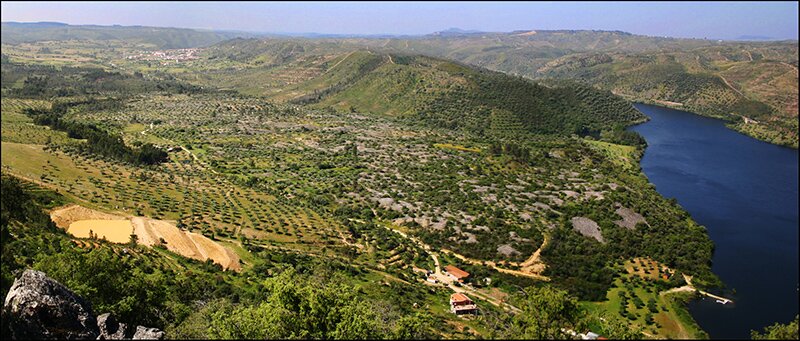
Overview of the gold mining site of the Conhal (photograph by D. Taelman)Overview of the gold mining site of the Conhal (photograph by D. Taelman)

Other important features that are related to the arrugia extraction technique and that are clearly visible in the Conhal landscape are the water evacuation channels, the remains of large water storage basins and the presence of aqueducts for the water provisioning of the mining activities.


Search

News


First impressions in "Recent activities"


Interview and photographs in "Recent activities"


Ammaia Report in "O Público"

-->

Copyright © 2010 Radio-Past.

Powered by WordPress and Hybrid. Operated by 7reasons
