• Home
  • Radio-Past
    • Project details
    • Research techniques
      • Airborne remote sensing
        • Traditional aerial imaging
        • Helikites and drones
        • NUV and NIR photography
        • LiDAR
      • Field survey
      • Geophysical survey
        • Earth resistance
        • Georadar
        • Magnetometer
        • Magnetic susceptibility
      • Topographical and geomorphological survey
        • Geomorphology
      • Groundtruthing
      • Virtual reconstruction
    • Partners
    • Reference projects
  • Open Lab Ammaia
    • Recent activities
    • History
    • Recent research
      • Aerial survey
        • Aerial photography
        • LiDAR
      • Surface artefact collection
      • Geo-archaeological survey
        • Gold mining
        • Stone quarries
        • Rural landscape
      • Geophysical survey
        • Earth resistance
        • Georadar
        • Magnetometer
        • Magnetic susceptibility
      • Topographical survey
        • Reference system
        • Digital elevation model
      • Field survey
      • Architectural scanning
      • Excavation
        • Trial trenching
        • Thermae excavations
      • Material studies
        • Artefact study
        • Laboratory analyses
      • Virtual reconstruction
    • Mapping the city
    • Archaeological park and museum
    • Bibliography
  • Multimedia
    • 3D-reconstructions
    • Maps and plans
    • Movies
      • RTP Report 1
      • RTP Report 2
    • Panoramic images
    • Photographs
      • Snow in Ammaia!
  • Links
  • Site map
  • Contact
  • Login
Browse: Home / Radio-Past / Research techniques / Geophysical survey / Georadar

Georadar

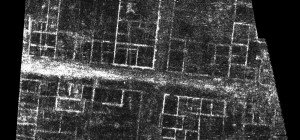
Image of GPR survey results with clearly visible Roman buildings and street network (elaboration L. Verdonck, Mariana survey)

Image of GPR survey results with clearly visible Roman buildings and street network (elaboration L. Verdonck, Mariana survey)

Georadar or Ground-Penetrating Radar (GPR) survey is based on the use of an electromagnetic radar wave propagated through the soil to search for changes in soil composition and the presence of structures, measuring the time in nanoseconds (ns) taken for the radar wave to be sent and the reflected wave to return. This technique has been applied successfully on a range of archaeological sites, in particular over substantial urban archaeological remains such as classical sites. As the method is generally slower than magnetic survey or earth resistance survey, it is more appropriate to apply this method to target particular areas of interest at an archaeological site where such other methods have already been applied, or where there is a potential for deeper archaeological deposits. Instruments used in archaeological survey generally have a propagation of radar waves down to a depth of approximately 3m to 4 m depending on the nature of the subsurface materials.
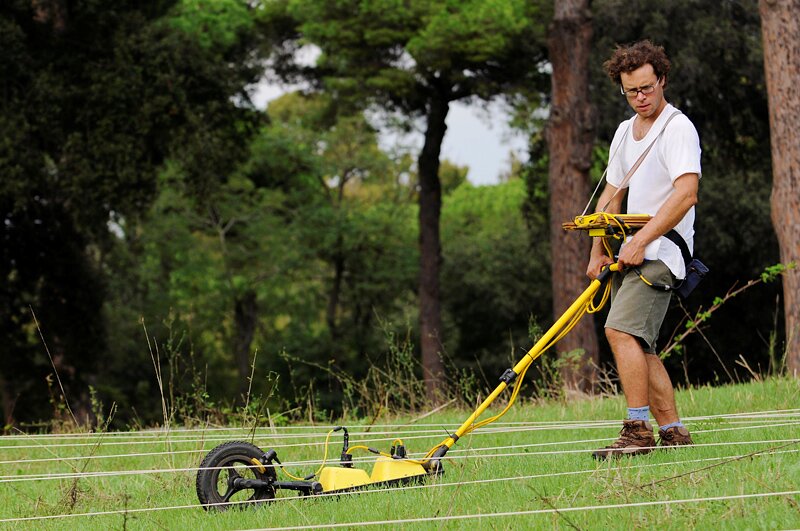
Executing a GPR survey (photograph by G. Verhoeven)Executing a GPR survey

Search

News


First impressions in "Recent activities"


Interview and photographs in "Recent activities"


Ammaia Report in "O Público"

-->

Copyright © 2010 Radio-Past.

Powered by WordPress and Hybrid. Operated by 7reasons