• Home
  • Radio-Past
    • Project details
    • Research techniques
      • Airborne remote sensing
        • Traditional aerial imaging
        • Helikites and drones
        • NUV and NIR photography
        • LiDAR
      • Field survey
      • Geophysical survey
        • Earth resistance
        • Georadar
        • Magnetometer
        • Magnetic susceptibility
      • Topographical and geomorphological survey
        • Geomorphology
      • Groundtruthing
      • Virtual reconstruction
    • Partners
    • Reference projects
  • Open Lab Ammaia
    • Recent activities
    • History
    • Recent research
      • Aerial survey
        • Aerial photography
        • LiDAR
      • Surface artefact collection
      • Geo-archaeological survey
        • Gold mining
        • Stone quarries
        • Rural landscape
      • Geophysical survey
        • Earth resistance
        • Georadar
        • Magnetometer
        • Magnetic susceptibility
      • Topographical survey
        • Reference system
        • Digital elevation model
      • Field survey
      • Architectural scanning
      • Excavation
        • Trial trenching
        • Thermae excavations
      • Material studies
        • Artefact study
        • Laboratory analyses
      • Virtual reconstruction
    • Mapping the city
    • Archaeological park and museum
    • Bibliography
  • Multimedia
    • 3D-reconstructions
    • Maps and plans
    • Movies
      • RTP Report 1
      • RTP Report 2
    • Panoramic images
    • Photographs
      • Snow in Ammaia!
  • Links
  • Site map
  • Contact
  • Login
Browse: Home / Radio-Past / Research techniques / Geophysical survey / Earth resistance

Earth resistance

Earth resistance survey is one of a number of different geophysical survey techniques that can be applied by archaeologists to record the remains of sub‐surface archaeological structures. It is based on the ability of sub‐surface materials to conduct an electrical charge passed through them. All materials will allow an electric current (i.e. the flowing of charged particles) to a greater or lesser extent. The technique is based on the creation of an electric current between probes in the earth to measure variations in resistance over a survey area.
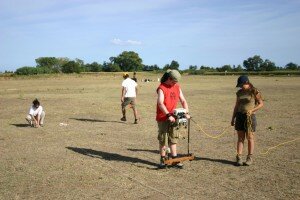
Electric resistivityResistance is measured in ohms (Ω), whereas resistivity, the resistance in a given volume of earth, is measured in ohm‐metres (Ω/m). Resistivity survey, has since many decades been very successful in archaeology, especially for locating walls, ditches, paved areas and banks, and the application of resistance tomography allows such features to be recorded at various depths.


Search

News


First impressions in "Recent activities"


Interview and photographs in "Recent activities"


Ammaia Report in "O Público"

-->

Copyright © 2010 Radio-Past.

Powered by WordPress and Hybrid. Operated by 7reasons
